
What is UX and Design Thinking?
What is UX? This is probably the question you asked yourself when you saw jobs on LinkedIn with this title, or read posts talking about its roles, importance, methodologies, and more.
Also as self-learning, because we are constantly feeding ourselves with new concepts. As Albert Einstein said: “The mind that opens to a new idea never returns to its original size.”
So, without further preamble, we will explain what the well-known—or not so well-known—UX is, what its methodologies are, and why it’s trending on LinkedIn.
What do the initials UX mean?
First of all, UX stands for User Experience.
Thus, as Buley (2013) points out, the UX methodology involves applying a series of methods and techniques to investigate what users want and need, and thereby design products and services for them.
It is defined as a process through which we identify a problem, understand the user, develop ideas, and implement solutions, always considering their needs rather than those of the designer.
The “user experience” encompasses the entire interaction a person has with your company, services, or product—in other words, how they feel before, during, and after experiencing any digital product or service.
To ensure these experiences are user-friendly, prior research must be conducted. These research processes have different phases that guarantee the best results.
How do the different areas in UX come together?
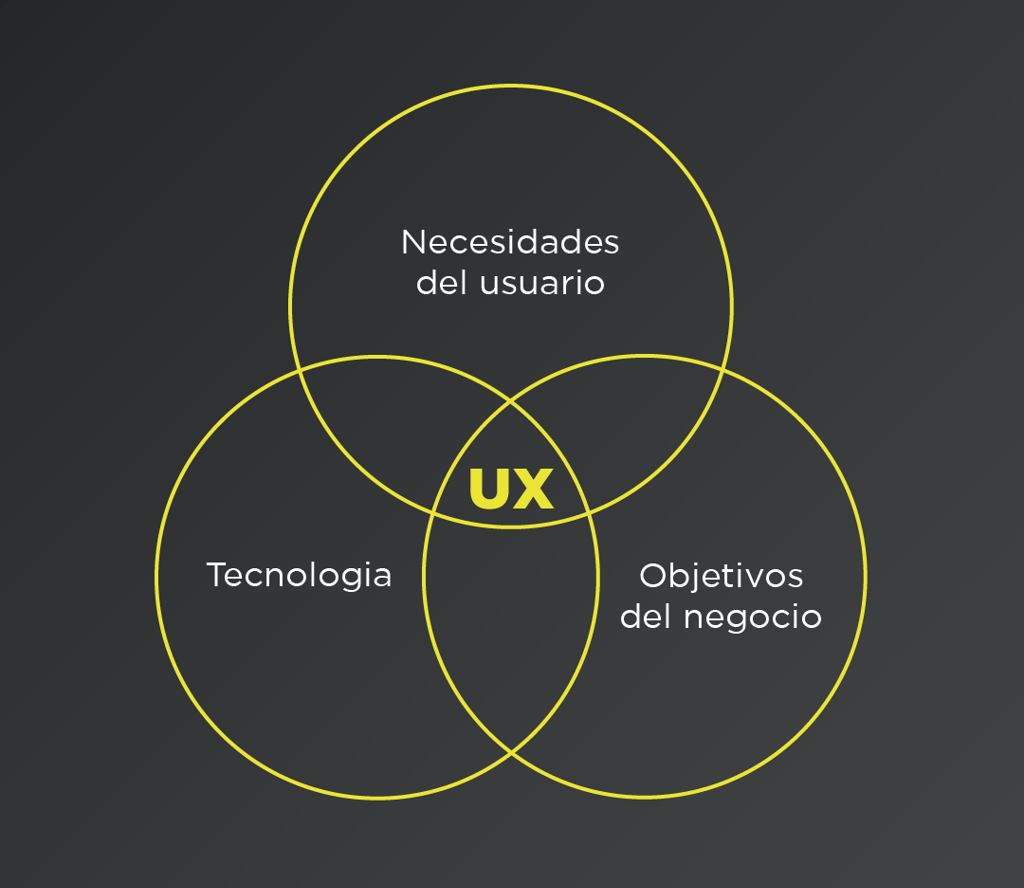
To understand how the different areas of an organization come together in UX, we must first define them:
· Technology: This area is important to consider in terms of feasibility, meaning: Is what we are doing technologically achievable?
· Business Objectives: Taking viability into account, from this area we ask: Is UX financially viable for the business?
· User Needs: And last but not least, in this area we have the factor of relevance, asking ourselves: Is it relevant to the everyday problems of users?
Design Thinking Methodology in User Experience
“A methodology that permeates the entire spectrum of innovation activities with a spirit of human-centered design.” — Tim Brown (2008)
This methodology is the most widely used in the world of product design. Its name can be translated as “design thinking,” which is nothing more than the way a designer thinks when creating proposals.
The term first appeared in 1987, with the book Design Thinking by Peter G. Rowe, which focused on architecture and urban planning.
Today, Design Thinking allows us to build innovative ideas by solving problems while focusing on solutions. Design Thinking can always be applied, since it is based on problem-solving from the user’s perspective.
The Phases of Design Thinking
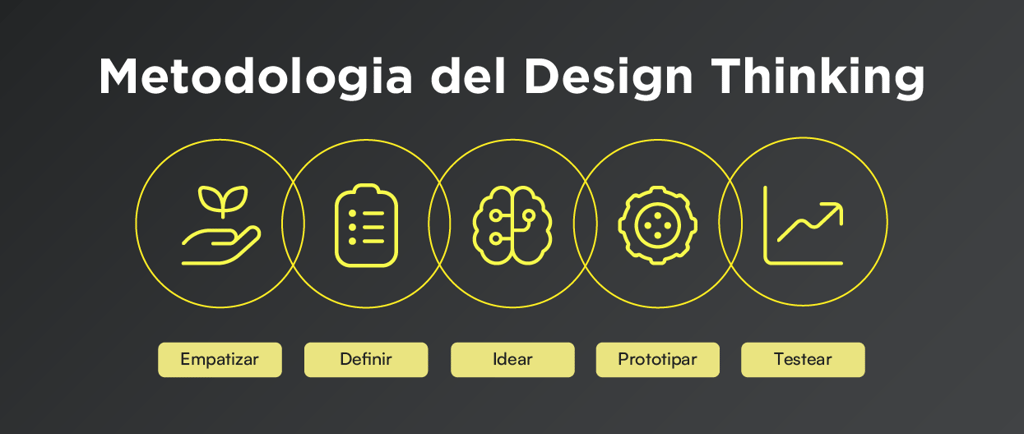
Now that we understand the concept of Design Thinking, it’s time to learn how to put it into practice. To do this, it is essential to know the stages that structure this method.
1. Empathize
Empathy is the fundamental basis of the human-centered design process. The first step is to deeply understand the clients and put ourselves in their shoes. In this phase, the goal is to know what users need, want, and like, so we can offer a solution tailored to them.
In other words, we aim to empathize with users’ needs, the characteristics of their context, and the problem we seek to solve. In this stage, design teams must “walk in their shoes” to understand their needs.
This first phase is key for completing the following stages. Techniques used at this stage include in-depth interviews, observation, and focus groups, among others. We also define the user archetype we are targeting, establish our research objectives, and decide on the techniques to use. The goal of this phase is to identify desires and needs relevant to our user persona.
2. Define
The second step is to define the problem. We need to filter all the information we have gathered to focus on the aspects that matter for the purpose of our project.
At this stage, we bring clarity and focus to our project based on what we have learned about the user and their context. Framing the right problem is the only way to create the right solution.
The goal of this stage is to develop a Point of View (POV) to have a meaningful and concise problem statement.
3. Ideate
"The best way to have a good idea is to have lots of ideas." – Linus Pauling
In this part of the process, we aim to generate as many ideas as possible to address the problem. This is the time for brainstorming and other tools such as mind maps, prototypes, and storyboards, which drive us to create a wide range of ideas.
It’s important to highlight that all ideas are valid and welcome, no matter how unconventional they may seem, because one idea may lead to another, more interesting one, and potentially an innovative solution. So don’t be afraid to let creativity and imagination fly!
4. Prototype
At this stage, we already have the idea—the solution to our problem—so it’s time to put it into practice.
Prototyping involves creating informative elements such as sketches, artifacts, and objects to answer questions that bring us closer to the final solution. This could be a post-it, an activity, or even a storyboard. Ideally, it should be something the user can interact with and test.
This process is refined as the project progresses, and prototypes gradually show more functional characteristics. When testing prototypes with users, it is essential to always ask: What do we expect to evaluate? What kinds of behaviors are we looking for?
5. Test
Finally, users try out the solution and provide feedback. This step involves asking for their opinions on the prototypes, which is a great opportunity to refine and improve solutions.
In this way, we achieve a solution tailored to their needs. Techniques used include heuristic evaluations, usability testing, A/B testing, among others.
A Design Thinking process is divided into these five phases. Once completed, the solution found and validated with the user can be enhanced in a new iteration. This iterative approach is its core strength: it’s designed to test and fail until the ideal solution is found.
At Aura, we work in UX to provide the best possible user interaction by collecting information about the product and studying its usage. Our guiding principle is applying Design Thinking to User Experience Design.
Say hello
Contact
hello@aurauxstudio.com
Buenos Aires, Argentina
About us
Services
UX Design and Development
Strategy & Audit


Let's design the future
Aura UX Studio 2024